

Beginner Camera Settings for Flan and Panna Cotta Without Losing the Wobble
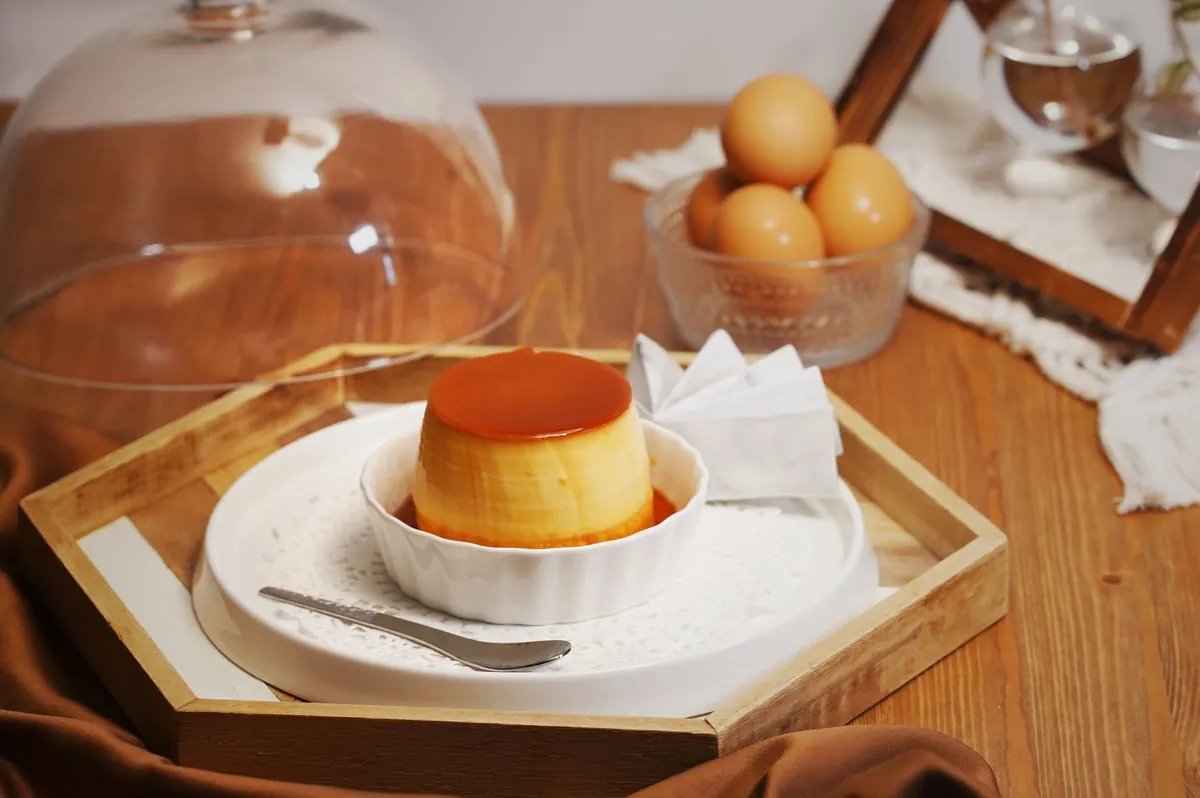
Flan and panna cotta are the two most contrary subjects in dessert photography. You can spend twenty minutes styling, get the caramel to a perfect amber, wipe every stray crumb off the plate, and then someone nudges the table. The custard shivers, your shutter drags across the movement, and you get a soft, hazy edge where a clean one should be. Or you panic, freeze everything with brute force, and the dessert ends up looking like a wax model in a museum case.
The wobble is not the enemy. It is the whole point. People photograph flan because it jiggles. What you want is a wobble that reads as silky and alive rather than smeared and vague, and four controls decide whether you get there: shutter speed, aperture, ISO, and where you place the focus point.
Start With Shutter Speed, Because Your Subject Is Moving
Most beginners treat a tripod as the answer to every sharpness problem. It isn't. A tripod stops your camera from shaking. It does nothing about a custard that is still settling on its plate. Those are two separate motions, and only shutter speed handles the second one.
As a working range, think of it this way. A flan that is barely breathing, maybe 1/125 second. A panna cotta just tapped on the rim, 1/250 to 1/500. A caramel sauce being poured over the top, 1/500 and up, because liquid moves faster than you think.
Below roughly 1/60 second, you are choosing to blur the custard. That can be beautiful. A slow shutter turns the surface into a soft, creamy gradient and hides the fact that your panna cotta has a slightly uneven top. Just make that choice on purpose rather than discovering it later on the computer.
The tap test
Before you shoot, tap the rim of the plate gently with a fingertip and watch. Count how long the surface keeps moving. A firm set takes about a second. A looser one can ripple for three or four. That ripple time tells you how much room you have, and it also tells you the best moment to fire: right after the tap, when the movement is at its peak, not after it has died down.
Aperture: How Much Custard Do You Want Sharp?
Aperture controls depth of field, which matters more here than with a stack of cookies, because a flan has real height. If your focus plane is only a centimeter deep, the front lip of the custard is sharp and the back slope falls apart.
For a single ramekin shot slightly from above, f/5.6 is a dependable home base. For a taller flan on a pedestal plate, drop to f/8 so the top and the base both hold. Save f/2.8 and wider for tight, moody frames where you deliberately want only a ribbon of custard in focus and everything else melting away.
The trade-off is light. Every stop you close costs you brightness, which pushes you toward a slower shutter or a higher ISO. If you find yourself at f/11 and 1/30 second, you have traded sharp custard for a blurry one. Open up instead.
ISO Is the Cheapest Fix You Have
Given a choice between a little noise and a smeared dessert, take the noise every time. Grain is survivable. A blurred wobble is not, because it looks like a mistake rather than a texture.
Some practical anchors. Next to a bright window in the afternoon, ISO 200 to 400 is plenty. On a cloudy day or in a room lit by a single lamp, ISO 800. Shooting after dinner in a dim kitchen, ISO 1600 without apology. If your camera handles 3200 well, use it and stop worrying.
Avoid the trap of leaving ISO at 100 because it feels cleaner, then dropping your shutter to 1/25 to compensate. You have just traded one imperceptible problem for a very visible one.
Where You Put the Focus Point Matters More Than the Mode
Autofocus can be genuinely unhelpful with a moving, glossy, low-contrast subject. Wide-area modes will happily lock onto the plate rim, the spoon, or the caramel pool instead of the custard. Take control.
- Switch to single-point autofocus. One small box, and you decide where it sits.
- Aim at the front edge of the custard, on the slope facing the camera. That is the part of the wobble your eye reads first, and it is closest to the lens.
- For very shallow apertures, focus manually in live view with magnification. Zoom in on the custard surface, turn the ring until the texture snaps, then zoom back out.
- Refocus after every tap. A wobble shifts the surface by a millimeter or two, and at f/2.8 that is enough to lose it.
Also give the camera a reason to stay still: a two-second timer, a remote release, or a cable, and a plate that is not sitting on a wobbly table. Your hands should be off the camera when the shutter fires.
Three Starting Setups You Can Copy
- Window light, single ramekin. 1/160 second, f/5.6, ISO 400. Camera roughly level with the custard, slightly above.
- Dim evening kitchen. 1/200 second, f/4, ISO 1600. Add a lamp behind the dessert for shape.
- Pouring caramel or sauce. 1/500 second, f/5.6, ISO 800. Burst mode, focus on the custard surface where the liquid lands.
Treat these as a starting line, not a rule. Change one value at a time so you can see what each one did.
Light the Wobble So It Actually Shows
Movement only reads if there is a highlight sliding across it. Flat, even light makes a jiggling panna cotta look exactly like a still one.
Put a soft light or a window behind and slightly to the side of the dessert. The bright edge along the top of the custard will shift and shimmer as it moves, and that shifting highlight is what tells the viewer the dessert is alive. A backlit flan, with the caramel glowing amber along its rim, does more for the sense of movement than any setting on this page.
Then shoot in short bursts, three or four frames, starting the moment after the tap. You will usually find one frame where the surface is lifting and the highlight is at its brightest.
Practice on a Bowl of Water First
Fill a small bowl with water, set it where you plan to shoot, and tap the rim. Shoot the ripple at 1/60, 1/125, 1/250, and 1/500. Compare the frames on your screen rather than on the back of the camera. Within twenty minutes you will know exactly which shutter speed gives you the silky, alive look you want, and you will have spent no custard doing it. Then make the flan, tap it gently, and shoot with a plan instead of hope.
Photo: SimplyArt4794 / Pexels